
How to reconcile accounts (cari mutabakat)?
Account reconciliation (cari mutabakat) is two businesses agreeing on the balance of the account between them as of a certain date, and it is done in five steps: agreeing on the cut-off date together, each side producing its own account statement, exchanging the statements, if there is a difference, finding its cause by looking at dates, not amounts, and recording the confirmed balance in writing. The document that completes a reconciliation is the statement; sharing only the balance figure doesn't show where a difference comes from.
Reconciliation is not a collection step. It pins down the amount of the debt; payment is a separate matter. But going into a collection conversation with an agreed balance moves the argument from the figure to the calendar.
Reconciliation in five steps
1. Agree on the date and scope first
Reconciliation starts with both sides looking at the same date range. Set a clear cut-off day such as “as of the evening of August 31” and write it to the other party. Statements sent without agreeing on the cut-off day almost never match: one side cuts off on August 30, the other on September 2, the invoices of the two days in between show up as a difference, and you go looking for a problem that doesn't exist.
2. Produce your own statement and check it before sending
Pull the statement with all transactions up to the cut-off day. Before sending, check three things in your own records: is there a carried-forward balance line, are there any lines with an empty description field, and is the same company sitting on two separate cards. A statement sent without fixing these three leads to your own mistakes being discussed on the other side. We explained how to read the statement on the what is an account statement page.
3. Send the statement and the balance together
A message that only says “your balance is ₺26,250” is not a reconciliation; the other party can't confirm it, only accept or object. Attach the transaction statement and ask a single question: “Does this statement match yours?” Email, WhatsApp or paper — the channel doesn't matter, what matters is that the statement is attached. Ask for the confirmation in writing; a verbal agreement is not remembered six months later. For a ready-made version of the text you will send, see the account reconciliation letter and email sample.
4. If there is a difference, look at dates, not totals
If the two balances don't match, don't try to split the difference. Bring the two statements to the same date range and compare the number of lines: on which date is there a transaction on one side that is missing on the other? The amount of the difference often matches a single document directly — a ₺7,250 difference means a ₺7,250 invoice is recorded on only one side. The difference itself tells you which document to look for.
5. Close the result in writing and record the date
Once the difference is resolved, put the balance both sides have confirmed in writing: “As of 31.08.2026 we agree on a balance of ₺26,250.” That sentence is the starting point of the next reconciliation — next time you only look at what comes after this date. Note the reconciliation date on the account card; when you last agreed with a customer is the first thing asked in overdue-receivable discussions.
When two statements don't match: a sample comparison
You are reconciling with a customer with a cut-off of 14 September. The final balance on your statement is ₺26,250, on the other party's ₺19,000. The difference is ₺7,250. Instead of splitting the total, put the lines side by side:
| Date | Transaction | Your record | Other party's record |
|---|---|---|---|
| 01.09.2026 | Opening balance | 12.000 ₺ | 12.000 ₺ |
| 03.09.2026 | Sales invoice A-1471 | 18.500 ₺ | 18.500 ₺ |
| 08.09.2026 | Cash payment received | −10.000 ₺ | −10.000 ₺ |
| 11.09.2026 | Return — 2 boxes | −1.500 ₺ | −1.500 ₺ |
| 14.09.2026 | Sales invoice A-1512 | 7.250 ₺ | missing |
| Balance | 26.250 ₺ | 19.000 ₺ |
The difference comes from a single line: invoice no. A-1512 dated 14 September never made it into the other party's records. 26,250 − 7,250 = ₺19,000. The fix is to send a copy of the invoice and ask the other party to record it. Note that the amount of the difference (₺7,250) pointed directly to the document to look for — this is the only method that works in reconciliation.
Where do differences most often come from?
| Cause | How to tell |
|---|---|
| Unrecorded collection | The difference equals the amount of a payment you made; check the receipt date. |
| Invoice entered twice | The same document number appears on two lines on one side. |
| Return or discount recorded on one side only | The difference equals the return amount; look for the delivery note (irsaliye) or the return invoice. |
| Cut-off day difference | The difference is the total of transactions around the cut-off day; it disappears when both statements are brought to the same day. |
| Two account cards for the same company | Your statement looks incomplete; check the cards by tax number. |
When a three-party transfer (virman) is recorded on only one side, the difference also equals the transfer amount; check the date of the transfer letter. How a transfer is written and recorded is on the what is an account transfer (virman) page.
Three habits that make reconciliation easier
1. Fill in the description field when you record. A line without an invoice number can't be compared during reconciliation. This is what shortens the time to find a difference the most.
2. Keep the range small. Two sides that reconcile monthly scan at most one month of transactions; those who do it once a year wade through hundreds of lines.
3. Keep the confirmation in writing. The agreed date and amount are the carried-forward balance of the next reconciliation. If it isn't in writing, you start from the very beginning every time.
How do you prepare the statement for reconciliation?
With Excel: you open one sheet per account, fill in the date–description–debit–credit columns, and carry the balance forward with a cumulative sum formula. The ready-made free account tracking Excel template is enough for a small number of accounts; as the number of accounts grows, selecting a date range becomes manual work.
With software: in Account Ledger: Debt & Credit you open the account card, select the range up to the cut-off date and get the statement ready; debit, credit and running balance come already calculated, and overdue transactions are visible on the same screen. If you want to manage stock and sales in the same program, Ofisx, and if you keep a credit ledger in retail, Veresiye Takibi may be a better fit; you can see which suits you on the comparison page.
We explained the debit-credit logic and how the running balance is built on the what is a cari account page, and the statement's columns and how to read it on the what is an account statement page.
Frequently asked questions
What does account reconciliation mean?
It is two businesses agreeing on the balance of the account between them as of a certain date. Each side pulls the transaction statement from its own records, compares them, and if there is a difference, finds the cause and closes it. Reconciliation is not a payment step; it pins down the amount of the debt, not the collection.
How often should reconciliation be done?
Once a month is a practical habit for accounts you work with regularly. Look more often at accounts whose balance is growing, whose payments are starting to run late, or that have many small transactions. In a reconciliation done once a year, both finding and fixing differences gets harder, because you have to scan the hundreds of lines in between.
What happens if the other party doesn't reply to the reconciliation?
Silence is not counted as confirmation. Record what you sent and when, and send one more reminder after a reasonable time. When collection starts to run late, having a note saying “statement sent on this date, no objection received” makes things easier for you.
Is there a problem if the balance matches but the transactions don't?
Yes. The same balance may have been reached by two different paths — for example, a missing invoice on one side and a missing collection on the other can cancel each other out. In that case the balance looks right today but breaks with the first transaction. What is compared in reconciliation is not just the last line but the entire statement.
What are the most common causes of a difference?
Four are at the top of the list: a collection one side didn't record, an invoice entered twice, a return or discount recorded on one side only, and the cut-off day being taken differently by the two sides. The fifth is the same company being kept on two separate account cards; in that case your statement is split and neither half shows the true balance.
Is a statement required for reconciliation?
It isn't mandatory, but what completes a reconciliation is the statement. Sharing only the balance figure prolongs the argument; once you send the transaction statement, the document where you diverge can be found in a few minutes.
Last updated: 2026-09-08
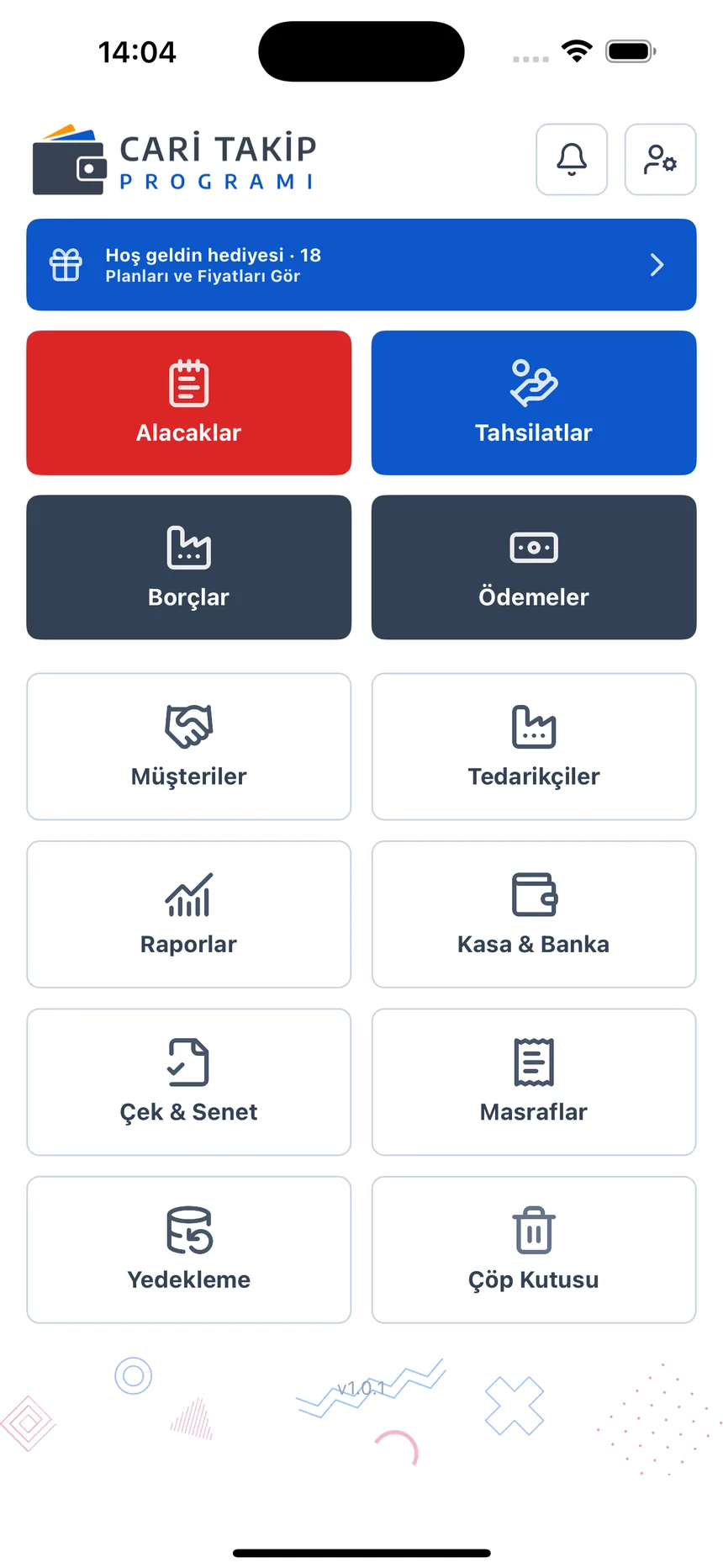
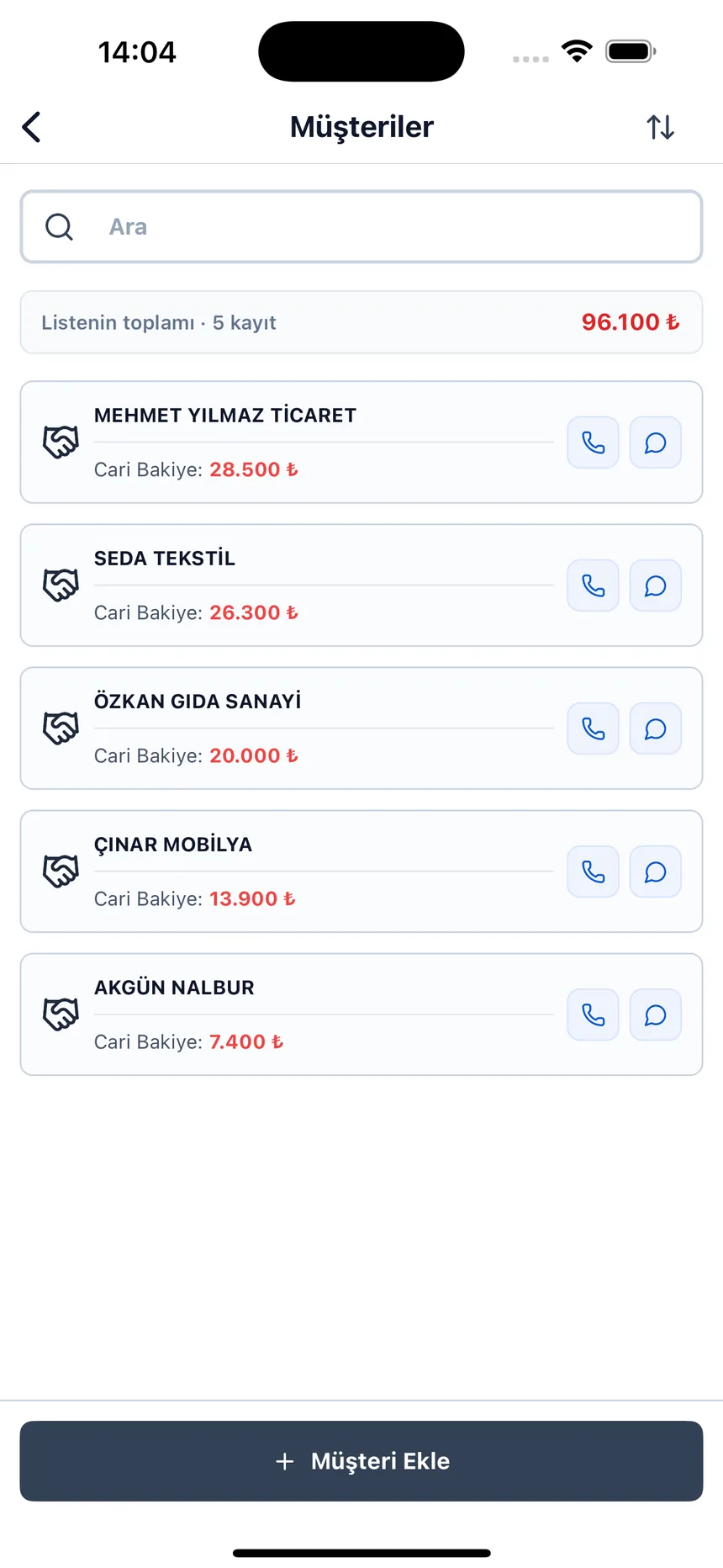
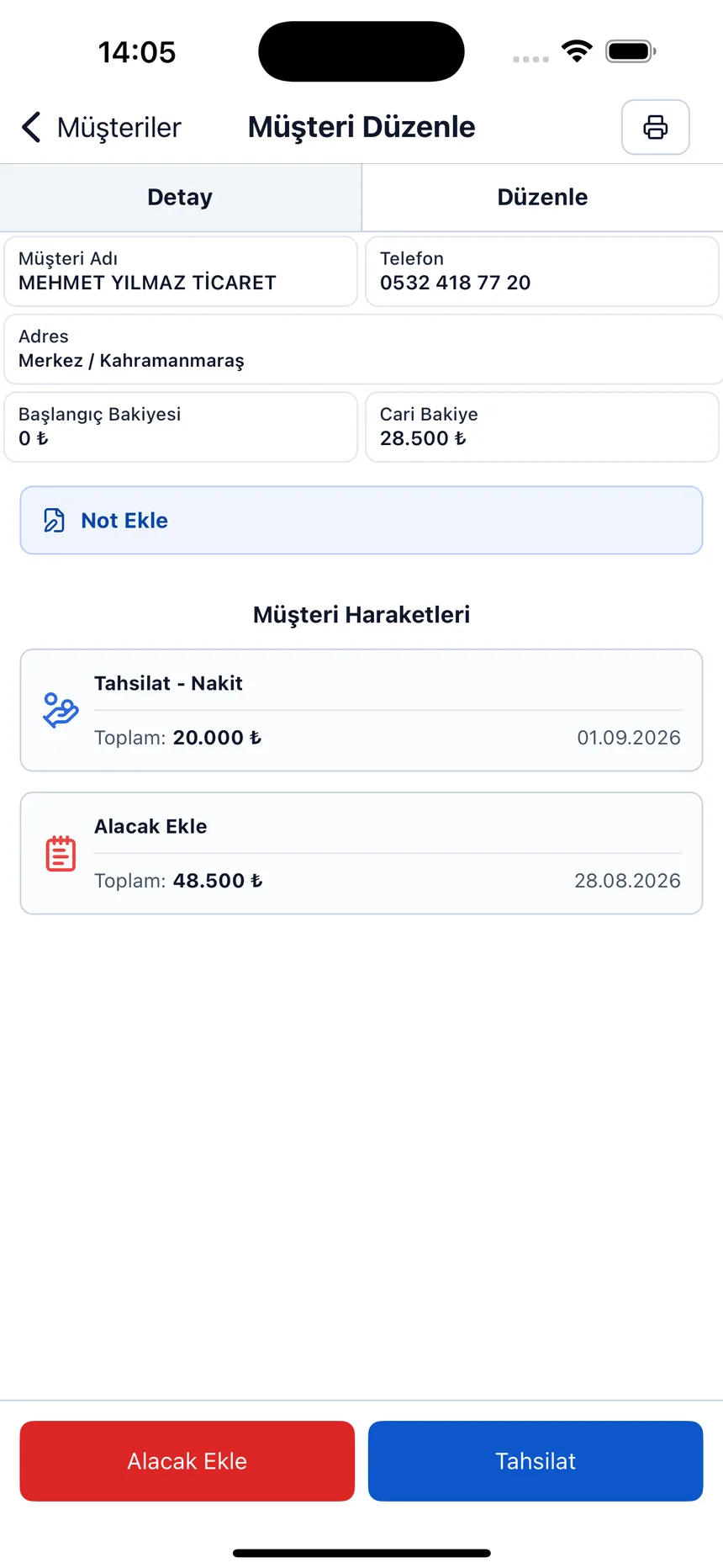
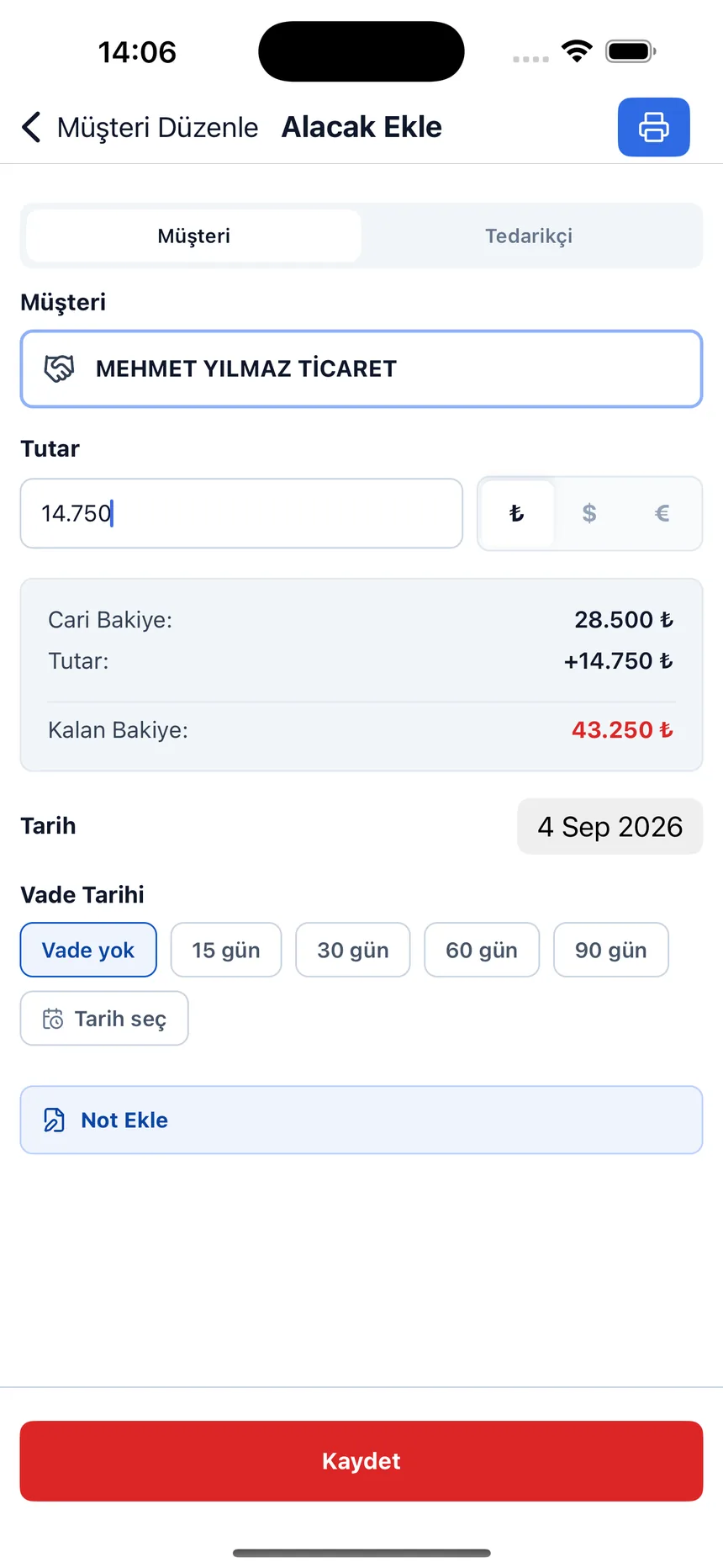
The statement screen in the app
Pick the cut-off date; the statement comes ready with debit, credit and running balance.
Don't hunt for statements on reconciliation day
Open a free account and let the statement build up as you enter transactions; all you need to do is pick the cut-off date.